Friday, March 22, 2013

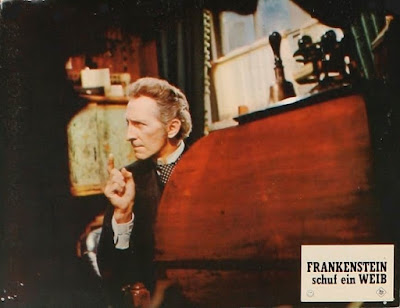
The Peter Cushing Scrapbook - A Centenary Celebration


There are two types of people.

One, let’s call them: Me, who lead a busy life and barely manage to write a measly blog post.

Two, let’s call them: Wayne Kinsey, who lead an even busier and more demanding professional life – I doubt that being a forensic pathologist is for slouches – and in the time that it takes me to write a few lines manage to publish yet another high quality book.

Wayne is one of only a small number of authors who have managed to set themselves up as a true authority on Hammer films and have helped us all to expand our shelves with books and magazines covering just about any aspect of Hammer’s extensive history and filmography.

So much so that it is virtually impossible to come up with a Hammer related topic that has not been covered yet and that doesn’t stray into the niche-niche market area.

Following up on last year’s Hammer on Locations, Wayne’s (and Peveril Publishing’s) next oeuvre strays from the general Hammer overviews and is dedicated to a topic that appears so blatantly obvious as a fan’s delight that it’s surprising it has never been covered before. Outside of his numerous acting roles, Peter Cushing has also become well known as a wonderful artist in his own right. He meticulously sketched character aides in the copies of practically all his screenplays, designed scarves and jewellery for his wife, drew cartoons in correspondence with friends, designed model theatres, painted water colours etc. Yet despite the fact that some examples of this vast output have been reproduced elsewhere, there has never been a proper overview over this aspect of Cushing’s portfolio.

Until now.

Very shortly we will be able to glance over The Peter Cushing Scrapbook - A Centenary Celebration. Brought together with the help of Cushing’s longtime secretary Joyce Broughton the book promises to be yet another keeper.

As for order information, Wayne writes:

“Full colour limited numbered edition (A4 landscape; 328 pages) with over 1800 photographs ONLY available from www.peverilpublishing.co.uk Keep watching the website and Peveril Publishing Facebook site for details of when sales go live late April/early May. Cover price £35, postage costs yet to be verified. We are not taking pre-orders but email peverilpub@aol.com or follow contact link on website to register your interest. Wayne will reply to these emails just before sales go live to ensure you get an early signed number.”


Friday, February 1, 2013

Mountain of the Cannibal God (IT, 1978)

I recently discussed this film with an online buddy and wanted to point him towards my little blog review here, just to notice that I had a review online on my older, now-defunct Hammer Glamour site but that I hadn't actually transferred it over yet. The review is a few years old and I haven't done anything in touching it up.


Amongst the general public horror movies have a pretty bad reputation. Splatter movies are considered even worse. Italian Splatter productions will raise more than just a few eyebrows, but admitting to watch Italian Cannibal movies with their ultra-gory effects scenes and real-life animal slaughter will have you hounded by PETA and is considered by most to be just one step ahead of a snuff enthusiast. God only knows so what caused real stars such as Ursula Andress and Stacy Keach to appear in one of these oeuvres but I guess we all have our bills to pay. Both actors could hardly have hoped to expand their fan audience by making a film clearly aimed at a very niche market.

Andress plays the wife of a researcher who went missing in the jungles of New Guinea. She goes in search of her husband with the help of adventurer Stacy Keach and under background tunes of Italo Pop musicians Guido & Maurizio De Angelis ("Oliver Onions"), stumbling across the occasional tribe or two of cannibals along the way. Not much in the line of surprises so but then again a decent story was usually the last thing on cannibal fans’ minds.What is on most cannibal fans’ minds, however, is the quality of the gore scenes. Though most of the natives seem to happily munch away any chance they get, it is usually animals they eat. The actual cannibalism occurs mainly towards the end of the movie. One especially nasty sequence that is often cut from available prints is a very realistic castration scene.


Director Sergio Martino leaves no stone unturned when it comes to showing animal snuff: Throughout the entire film we are constantly reminded that this is a dog-eat-dog kinda world and get to watch natives ripping apart a lizard or a snake slowly suffocating a monkey. In an Anchor Bay DVD Martino was asked about the latter scene and commented that this scene happened naturally while walking past the snake, and that he in actual fact did nothing but hold the camera in order to film nature at play. Following this claim the interviewers then presented Martino with clips of film that clearly showed that the monkey was thrown at the snake for dubious entertainment’s sake. Somehow Natural Geographic never had to resort to these means for their documentaries. Needless to say after that stunt Martino will hardly be available for future interviews of the kind.

Looking at the bright side: Andress does have two nude scenes. In the second one she is covered in white paint by some of the tribe women. Much to the male viewers’ delight, Bo Derek a few years later suffered a similar fate in her husband's, John Derek's, adaptation of Tarzan, the Ape Man (1981). Andress had also been one of Derek's wives at one stage, so I wonder whether he closely followed her films and was actually inspired by Andress' stunt in this production.

Another scene that is quite memorable – though, of course, on an altogether different level - is seeing the lost researcher’s corpse with a Geiger counter instead of his heart. Andress’ "surprise" character twist, however, towards the end of the movie comes as no surprise whatsoever to anyone familiar with staple Italian horror fare. And Stacy Keach’s character comes to an untimely death, probably caused by budgetary restraints.

Overall, this is a film that finds it hard to please anyone: Too tame for cannibal gorehounds, it is still too heavy to please the average cinema audience who may have expected to watch a run-of-the-mill adventure story when coming across a picture like this starring two otherwise bankable movie stars. 

The film has repeatedly been released but to the best of my knowledge the Anchor Bay release is the only one uncut.


Wednesday, January 30, 2013

Where is the Ghoul?


Has it ever struck you that we have no idea where The Ghoul is set?
Me neither, until relatively recently. But when you watch a film as often as I’ve watched this equally beloved and maligned Tyburn showstopper (I believe the correct medical term is ‘too often’), it is inevitable that you start to think about it in ways and to degrees that its infrastructure was never designed to reward or uphold. 

Now, some films tell you where they are set and some films don’t: no big deal.
But The Ghoul is intriguing because it mentions one location and one only: Land’s End, the ultimate destination of the car race that lands the four heroes in so much cannibalistic trouble.
But we don’t know if they actually get there, or, if not, how close they get by the time disaster strikes. And we don’t know where they start from either.
I had always lazily assumed that it was indeed in the vicinity of Land’s End that they find themselves stranded, but we are never actually told this for sure. The unhelpful local policeman has some kind of a Westcountry accent, but we are not explicitly informed even of the county. I also assumed, even more lazily as it turns out, that they started from London, and was frankly amazed, when I double-checked, to learn that my assumptions are completely unsupported by anything in the film itself. Neither is it at all likely, since the only assistance we are given is the observation that Land’s End is “over a hundred miles” from where they begin, immediately corrected to “more like two.”

Land's End, Summer 2012

Every year the wife and I spend a week with my parents at an inn just inland of Land’s End, and most mornings I get up at 5 and enjoy the lonely cliff walk to England’s most southerly point as dawn rises.
As many of you will know, Land’s End itself is now a giant tourist attraction, a shopping village cum theme park which is, I’m sure, a living hell during the day, when it’s crammed with soggy visitors and you have to pay to get in. But first thing in the morning even this is beautiful: eerily quiet (and who doesn’t love the idea of wandering through a totally deserted tourist attraction?), the whistling wind the only sound, and dozens upon dozens of rabbits the only living things in sight.
I’d like to say I spend most of my time on these walks pondering the deep mysteries of existence and the universe, and it’s true, when the first rays of the sun hit those timeless rocks, standing now just as they have through the whole history of human life in this most primitive and inspiring of lands, I do have my moments. But by and large, I’ll be honest, I’m thinking about The Ghoul.


There’s a large, somewhat eerie, strangely melancholy white house en route (above), all alone in extensive but featureless grounds, that I always liked to think was the original location of Dr Lawrence and his oddball household. But now it seems unlikely that Daphne, Angela, Billy and Geoffrey ever got this far.
Just how near did they get?

So, over breakfast one morning I put the matter to my dad, who’s much better at this sort of thing than I am.
Here’s the challenge, I explained: Four people in the 1920s are attempting to drive to Land’s End. Let us suppose that they live in a reasonably large town, given their wealth, awareness of fashions in an age of limited media, and the large number of like minds attending their parties. Their destination is between one and two hundred miles from the start point, and somewhere, along the shortest and most reasonable pre-motorway route, they pass through boggy moorland and become stranded. (Since both cars separately end up there, it is reasonable to suppose that neither took a wrong turning.) So where have they probably started from, and where have they probably ended up?
The first thing you can do, he told me – long before you need to get specific with a map and compasses – is rule out London. Given the distances involved and the time taken, it is simply not a logical candidate for home base at all.
Now, if you draw two circles on a map, one representing 100 miles from the radial point of Land’s End and the other two hundred, and assume that the start point must be somewhere within those two circles, the range of possibilities is surprisingly small. A lot of it, of course, is underwater, and given that our heroes travel by car we can rule that out as confidently as London, if not more so.
Among the dry bits, my father reckons, the most likely candidates, from a shortlist that also includes Southampton, Yeovil and Salisbury, are Bristol, Bath and Bournemouth. I have decided to go for Bath, because I happen to live there, and it’s nice.
Now, where do they end up? Not a lot of moors on that route, and the only possibilities are Exmoor, Dartmoor or Bodmin Moor, with the latter by far the most likely, and the only one in Cornwall. It’s an appropriately misty, marshy and mysterious place, with many secluded corners, steeped in folklore and legend. (Not sure that any of its inhabitants needed to sleep inside mosquito nets, even in the 1920s, but we’ll allow Anthony Hinds that much dramatic license.)
Therefore, I propose that they set off from Bath and, with their target almost in sight, became stranded somewhere on Bodmin Moor.

I hope that’s put your mind at rest.

If only they had made it, I'm sure they'd have spent a more than comfortable night  in this splendid art deco hotel on the cliff walk between Land's End and Sennen Cove ...

... but they'd probably have been made less welcome at this magnificently austere temperance hotel on Land's End itself.

The other mystery about The Ghoul, of course, is just how that poor bugger ended up the way he is in the first place.
All we know is that he joined a decadent, evil sect and was corrupted by the experience. But then what? Did he catch a disease, or was he cursed, or what? By what process does falling into bad company leave you with rotten green skin and the desire to eat people?
And what happens if they don’t give him human flesh? Will he die – surely for supernatural rather than physiological reasons, if so? Would his system really know the difference if they brought him pork chops and just pretended it was prime cuts of Veronica Carlson?
These and other questions will be explored in my forthcoming five-volume study What Kind of Ghoul Am I?

(By Matthew Coniam Photographs by Angela Coniam)

Friday, November 23, 2012

Christopher Gullo: The Films of Donald Pleasence (Review)

One often gets the impression that little is left to uncover when it comes to book projects pertaining to classic horror and fantastic cinema. It frequently feels that publishers are clutching at straws when they greenlight books about the memories of the guy who cut the lawn for Dwight Frye's second cousin's next-door neighbour. Yet every once in a while something comes along that makes you turn back and ask if it really can be true that no-one has ever covered that topic before and, by the way, why didn't I come up with that idea!

Christopher Gullo's The Films of Donald Pleasence is an example for one of those books.

17 years after his death (has it really been that long?) and despite having a large and loyal fanbase and having participated in more than a hundred movies (and a similar number of TV productions), many of which have become cult classics, this is the very first book ever written about “The Man With the Hypnotic Eye”.

Having been a prisoner-of-war in WW2, an experience that was going to haunt him until the end of his life and that influenced his performance in The Great Escape, Pleasence quickly restarted his early acting career after the war in London stage productions and from there gradually moved to film and TV roles. Though today he is most easily recognised as psychiatrist Sam Loomis from  John Carpenter's Halloween series – speaking about waiting your whole life for a career defining moment -, reading this book it becomes apparent that the most important role of his acting career was likely that of Harold Pinter's The Caretaker, a part that he made very much his own in both the stage and the movie versions.

He defined the Bond villain persona so much that it was his Blofeld that was parodied in the Austin Powers movies and on top of appearing in numerous jungle war flicks late in his career for the paycheck alone he also found the time to pen a children's book Scouse the Mouse and record a song that at this time of year just beckons to be unearthed again: Snow up your nose for Christmas (with lyrics by Ringo Starr).

Oh, and he also played in one Hammer movie: Hell is a City.

The format of the book follows the standard of the old Citadel publications:

A large introductory biography compiled with the help of interviews with some of Pleasence's family, friends and colleagues (including his wife Linda, daughter Angela, John Carpenter, Kevin Connor and Ulli Lommel) is followed by a film-by-film critique consisting of a cast overview, a synopsis and a review of the film in general and Pleasence's performance in particular.

The emphasis is very much on his movie work with some of his TV roles briefly mentioned but not much accentuated upon. If there is one thing I would have preferred it is to see a stronger additional emphasis on that part of his career in exchange for less of the synopsis, an area that I routinely just skip over whenever I come across them in movie books.

Still, this is a very good introductory work on this hitherto ignored actor that will hopefully encourage additional research that may ultimately expand to a full blown biography.

In the meantime, however, we still have a long way to go with Pleasence before we reach the point of oversaturation.

Tuesday, September 25, 2012

Christopher Gullo: The Films of Donald Pleasence

Christopher Gullo is a good buddy of mine and somewhere up there in the world's Top 10 of Peter Cushing Fans. Ever since the late 1990s we've been communicating about the Gentle Man of Horrors. in 2004 he published In All Sincerity, Peter Cushing, a wonderful overview of the actor's life and career as told to Chris by many of Cushing's co-stars, friends and colleagues. (Incidentally I only just noticed now that there is also a cheap Kindle version of that book available that at $3.39 is quite a steal.)

He has now finished his next oeuvre dedicated to the wonderful Donald Pleasence, an actor who for some reason totally beyond me has so far never received the biographical treatment he so well deserved.

Chris is now closing that gap and in conjunction with Bear Manor Media will soon release The Films of Donald Pleasence.

Please find below some additional info about the release:

Mention the words "horror star" and certain names immediately spring to mind-- Boris Karloff, Bela Lugosi, Peter Cushing, Christopher Lee, and Vincent Price. But another, lesser-known name was also heavily involved in numerous horror and science-fiction films-- Donald Pleasence. Featuring a distinctive look, memorable voice, and a serious approach to his roles, Pleasence shined brightly in many genre favorites. Whether as a maniacal body snatcher in The Flesh and the Fiends, a surgical assassin in Fantastic Voyage, the arch-villain of 007 in You Only Live Twice, a sarcastic inspector in Raw Meat, or his career-defining role as the heroic Dr. Loomis in Halloween, Donald Pleasence proved himself to be a top performer in the fantastical genres of horror and science-fiction. The Films of Donald Pleasence includes a full biography, tributes from Pleasence’s friends and coworkers, reviews of all his films, and a rare photo gallery in the first-ever book devoted to the man who became a genre favorite to countless fans.
To learn about this or other BearManor Media titles, please visit our website at www.bearmanormedia.com.
ISBN: 1-59393-212-X
Format: Softcover; 6” x 9”; 316 pages
Price: $21.95
Available also through Ingram and amazon.com
About the Author: Christopher Gullo is a history teacher and a life-long fan of genre films who resides in Long Island, NY with his wife Beth and son Anthony. His first book was In All Sincerity...Peter Cushing and he still runs the Peter Cushing Association on Facebook. In addition, Christopher has contributed to various books, magazines, and DVDs.

Sunday, September 9, 2012

John Hamilton: X-Cert

Let's see...

We have books on Hammer. Lots of them.

We have an excellent overview over Amicus courtesy of Little Shoppe of Horrors #20 and a controversial Dark Side publication Amicus: The Studio That Dripped Blood. The original author did an Allan Smithee and removed his name but say what you like about the contents this is still beautifully illustrated.

In recent years we also got Beasts in the Cellar: The Exploitation Film Career of Tony Tenser to focus on Tigon Productions. (I haven't read this yet but according to all the people whose opinions I value, this has my name on it.)

So what is left in terms of a more specialised approach to Classic British Horror?

Ah yes, an overview over the independent UK Horror movies of the time.

John Hamilton, author of Beasts in the Cellar, has now taken on the task of filling that gap on the book shelf.

X-Cert - The British Independent Horror Film: 1951 – 1970 does exactly what it says on the tin.

Published by Hemlock this volume will be instantly familiar to those who have previously read Bruce Hallenbeck's recent Hammer books. It features the same size and style of artwork and is richly illustrated, mainly in black & white but also with a separate 8-page coloured spread.

Given the complexities of film financing and international co-production deals at the time Hamilton mentions in his introduction the difficulties in coming up with a definitive list of what constitutes a) a British, b) an Independent and c) a Horror film and freely admits that his list is probably subject to debate. As such I am not even going to bother arguing which films should or should not have been included and am just enjoying his chronological overview of all the films from Mother Riley Meets the Vampire to The Corpse/Crucible of Horror.

Each of his entries is rich in historical detail and intelligent critique and low on synopsis just as it should be.

As this book primarily focuses on x-certified “adults only” movies of the time we get a good overview over the changing mores, involvements with the censor and political legislation with regards to film productions during those two decades.

Hamilton also manages to place the various cinematic talents in their respective career paths:

For one we have the usual genre stalwarts, often on a break from Hammer, such as Terence Fisher, Peter Cushing, Christopher Lee, Boris Karloff, Anton Diffring or Michael Gough.

Even more interesting, however, are those that are on either end of their career spans: a young Sidney J Furie directing Dr Blood's Coffin or helping to supervise the making of Devil Doll; a mature Joan Crawford going Berserk! for Trog.

For some like Michael Powell producing a film like Peeping Tom would put an end to an illustrious career. For others like Bryant Halliday (Devil Doll, Curse of the Voodoo, The Projected Man) these films were practically the sole reason that they still feature somewhere in the footnotes of cinematic history.

The book is full with details about short-term production companies such as Planet, Gala or Eros Film Distributors some of which were only ever set up for one film to avail of a government deal, then were disbanded or re-formed under a different name to ensure that they would again be eligible for the very same State sponsorship.

If there is one single name that comes up time and again providing something of a narrative throughout the two decades' worth of indie film history it is that of  Richard Gordon. He was single handedly responsible for the largest bulk of the movies in this book. Having established a friendship with him over the years, the author then rounds up this tome with a very personal and heartfelt remembrance of this multi-talented business- and showman who – outside of the Great Three Studios – did most to provide the British public with their share of chills and thrills.

If there is anything major that this book could be criticised for it is mainly by sins of omission. I personally would have loved to see the topic extended to the 1970s, a decade that probably proved to be the most fascinating for British Independent Horror films with the likes of Pete Walker, Norman J Warren or Mike Raven around.

A little birdy has, however, told me that a possible follow-up volume may be on the horizon at some point in the future which will no doubt make a great companion piece to this edition.

X-Cert is available both through sellers at Amazon US and UK as well as through Hemlock's own website.


Hammer hosts YouTube Channel

For the last month Hammer Films have started hosting their own YouTube channel. It's well worth checking out as on top of clips, trailers and previews it also features the following full-length Hammer movies each of which also has a separate introduction by Hammer historians Robert Simpson and Marcus Hearn.


Hammer also appears to have Man Bait/The Last Page made available though apparently not for Ireland where I live as all access is blocked.